
Put system context behind vulnerability decisions.
Keep evidence and inference separate.
Artemes AI combines observed endpoint state, curated vulnerability intelligence, and analysis with practitioner review to help teams prioritize findings and evaluate remediation guidance.
Architecture Components
Technology names identify architecture components and do not imply a commercial partnership or endorsement.
A finding still needs context before it becomes a decision.
Matching packages to CVEs identifies useful candidates for review, but a version match alone does not establish the state or priority of a deployed asset.
Configuration, runtime state, exposure, business importance, and compensating controls can all change what an operator should validate or remediate next.
The missing decision layer
A long findings list does not explain whether a vulnerable component is running, reachable, important to the business, or already covered by another control.
Illustrative workflow
Example observation: package present; execution not observed.
Example observation: service is behind a restricted network boundary.
Example observation: root SSH access with password authentication on a public listener.
How Artemes adds system context to vulnerability findings
A workflow designed to preserve provenance, expose missing context, and keep consequential decisions reviewable.
1. Deep Telemetry
Fleet and osquery collect scheduled Windows and Linux endpoint observations for storage and deterministic analysis.
2. Contextual Analysis
Draft analysis can consider observed configurations, running processes, exposed services, and network state alongside package versions.
3. Reviewable Output
Review prioritized findings, supporting evidence, missing context, and recommended validation or remediation steps.
AI output supports practitioner decisions and requires review. It may be incomplete, incorrect, or inappropriate for a particular environment.
Vulnerability management built for modern SecOps workflows.
Classification Grounded in Evidence
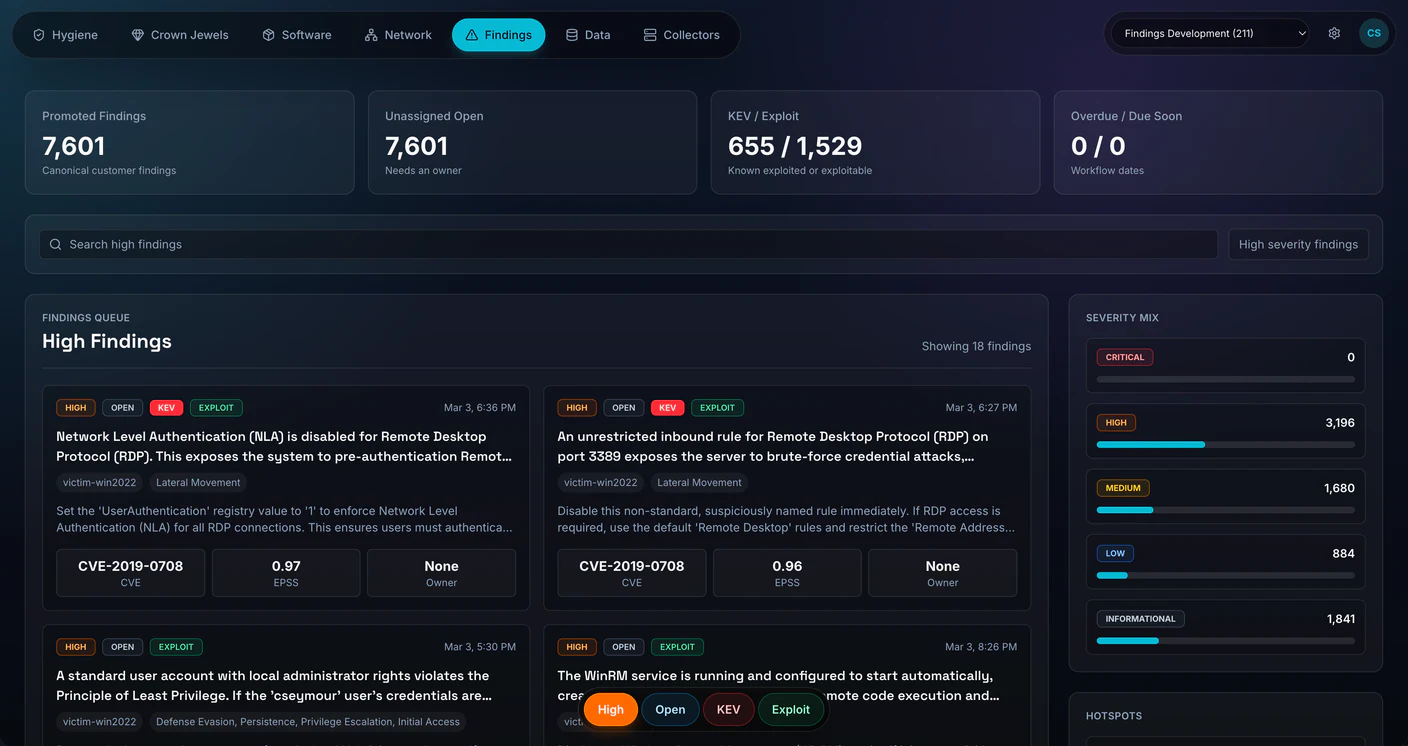
Findings can incorporate observed configuration, runtime, listener, exposure, asset, and control context. When evidence is missing, the workflow records the gap instead of assuming an answer.
Reviewable Remediation Guidance
Recommendations retain the evidence and reasoning behind a finding so practitioners can validate the next step before making a production change.
Separate Workflows for Each Customer
Selected API routes keep findings, assets, context review, assignments, due dates, reports, and dashboard summaries within the selected customer context.
Illustrative interface—not a customer result or guarantee.
What the workflow preserves
Each stage has a defined evidence boundary and review purpose.
| Stage | Recorded evidence | Decision boundary |
|---|---|---|
| Telemetry | Observed endpoint state with timestamps and source identifiers | What the endpoint reported |
| Reference enrichment | Sourced KEV and EPSS data, plus reviewed links between software and CVEs | What the cited source supports |
| Context analysis | Evidence, confidence, missing context, and draft reasoning | Unsupported claims are blocked or left unknown |
| Review | Quality checks, review decision, notes, and provenance | A person controls promotion |
| Workflow | Finding state, assignment, due date, and history | Operational ownership remains explicit |
Deterministic telemetry path
Fleet/osquery observations can be retained in BigQuery for scheduled analytics, provenance, and replay.
Sourced vulnerability context
CISA KEV and FIRST EPSS facts are ingested as reference data and joined after a reviewed match links software to a CVE.
Guarded promotion
Draft AI analysis is checked for unsupported exposure, threat, outcome, severity, control, and compliance claims before controlled promotion.
Add control context without overstating compliance.
Curated mappings can connect observed technical evidence to relevant control context and verification steps. A mapping does not establish certification, compliance, or control effectiveness.
Bring evidence and review into vulnerability decisions.
Join the early access program to evaluate Artemes AI against your telemetry, prioritization questions, and review requirements.
Early access is an evaluation program. Security decisions and remediation changes remain subject to practitioner review.